
The World Cup has been running since 1930 and across 96 years of tournament football it has accumulated an extraordinary collection of records, accidents and stories that sit just outside the mainstream narrative. Some of these are from ancient tournament history. Several are specific to 2026. A few come from our own data. All of them are true.
1. One stadium has hosted three World Cups
The Estadio Azteca in Mexico City is the only venue in history to have staged games at three separate World Cups. It hosted nine matches in 1970, including the Italy vs West Germany semi-final that finished 4–3 after five extra-time goals, and nine more in 1986, including the game in which Diego Maradona scored both the most controversial and the greatest goals in the competition's history within four minutes of each other. In 2026 it hosts the opening game and four further matches.
2. The last time the USA hosted, the opening day had nothing to do with football
The 1994 World Cup opening ceremony in Los Angeles took place against the backdrop of one of the most televised events in American media history - OJ Simpson's car chase, which was being broadcast live on every major network at the same time. The ceremony itself then added its own chaos: Oprah Winfrey injured her ankle after falling from a stage, and Diana Ross, presented with an open goal from three yards as part of the pre-match entertainment, somehow missed it. The actual opening game, Germany beating Bolivia 1–0, was considerably less eventful.
3. The 1930 World Cup final used a different ball in each half
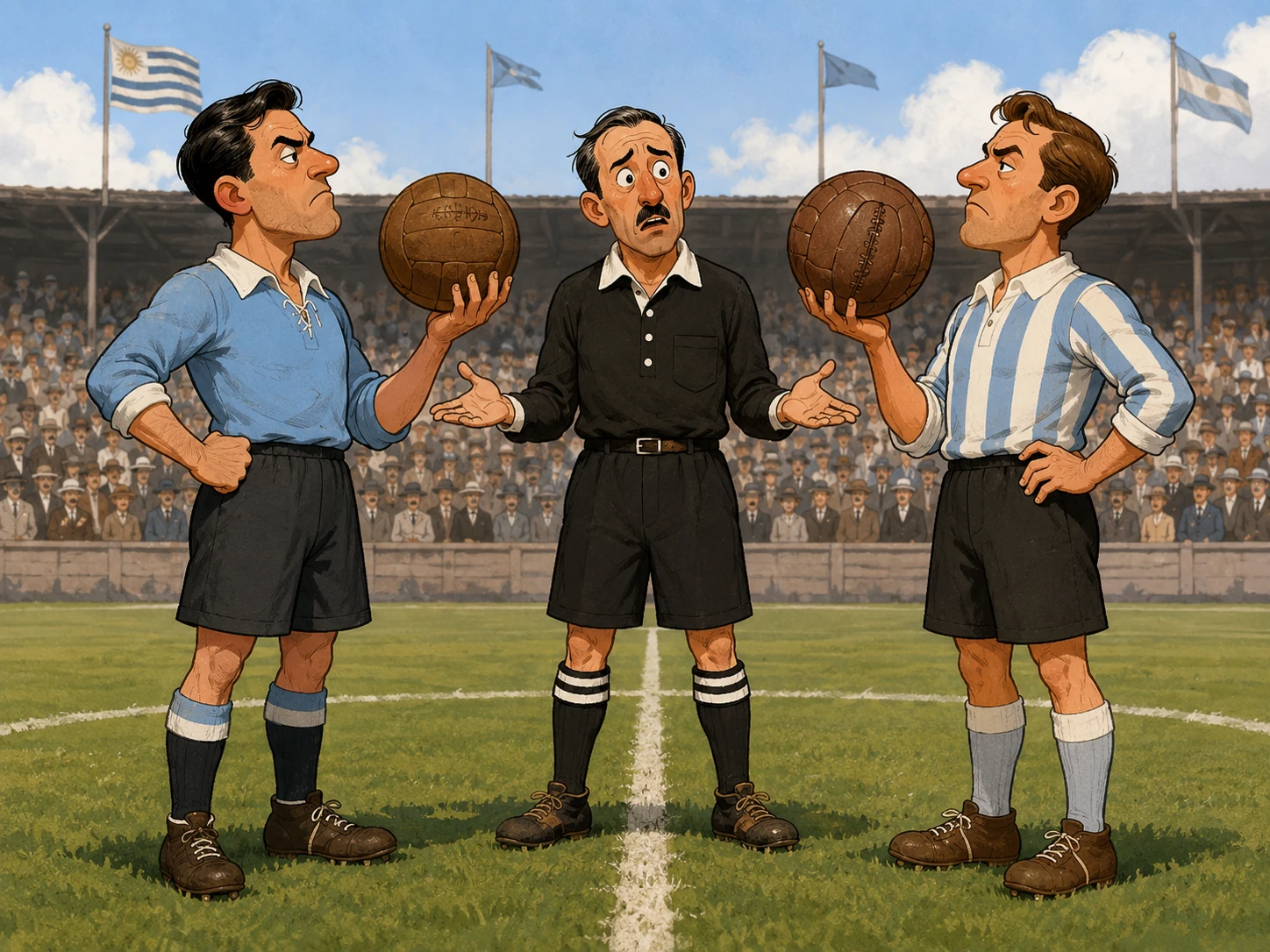
Uruguay and Argentina could not agree on which ball to use for the inaugural World Cup final. The solution was characteristically pragmatic: Argentina's preferred ball was used in the first half, Uruguay's in the second. Argentina led 2–1 at the break. Uruguay won 4–2. Whether the change of ball influenced the outcome is left as an exercise for the reader.
4. The USA's team doctor became the patient at the 1930 World Cup
During the semi-final between the United States and Argentina in 1930, the American team's trainer came on to treat an injured player, dropped his medical bag in the process, and broke a bottle of chloroform he was carrying. The fumes rendered him unconscious and he had to be carried off the pitch himself, leaving the player he had come to treat still waiting for attention.
5. Scotland once took 13 players to a World Cup that allowed 22
In 1954, following a dispute with Rangers, the Scottish Football Association sent a squad of just 13 to Switzerland, 11 outfield players and two goalkeepers, despite being entitled to bring 22. The manager resigned after the opening match, a 1–0 defeat to Austria. The selection committee then took charge for the second game against Uruguay. Scotland needed a win to progress, and lost 7–0, still their heaviest ever defeat. They were eliminated without scoring a goal.
6. A dictator threatened the Zaire squad before a 1974 World Cup game
The last time DR Congo appeared at a World Cup they were competing as Zaire, and doing so under considerable duress. After losing heavily in their opening two games, the squad received a message from President Mobutu Sese Seko warning that if they conceded more than three goals against Brazil, the consequences for the squad and their families would be severe. Shortly before a Brazil free-kick, defender Mwepu Ilunga broke from the wall and booted the ball away before the Brazilians had touched it. Every commentator assumed he had completely misunderstood the rules. He had not. Brazil still won 3–0, but the threat had been neutralised.
7. A player scored five goals in a single World Cup game - and was knocked out the next day
At the 1994 tournament, Russia's Oleg Salenko put five goals past Cameroon in the group stage, a record that has stood for over thirty years and may stand forever. Those five goals were enough, on the same day as Bulgaria's Hristo Stoichkov scored four against Greece, to win Salenko a share of the Golden Boot as tournament top scorer. Russia were eliminated from the group stage the following day.
8. The World Cup trophy was found by a dog
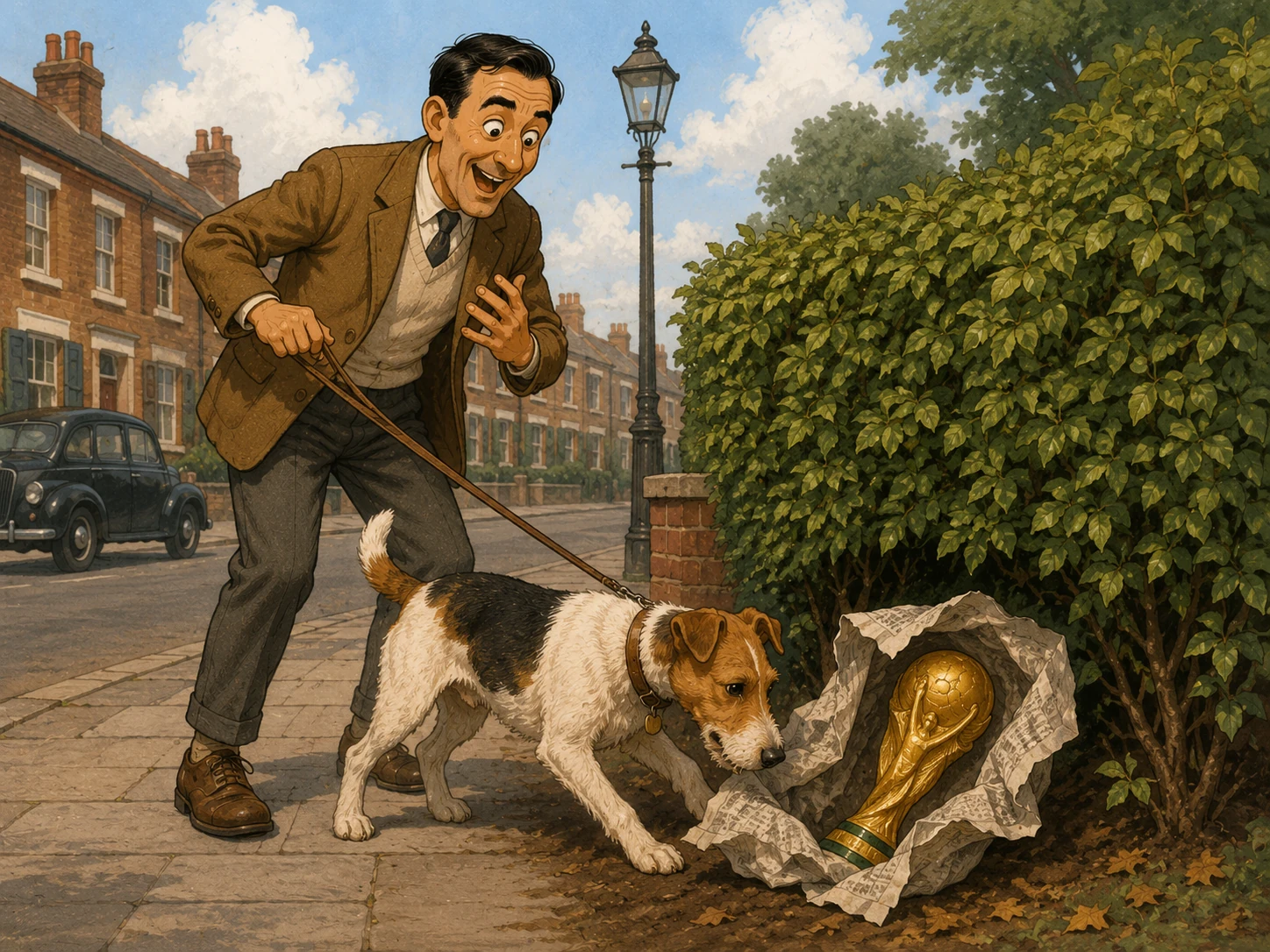
In 1966, weeks before England were due to host the tournament, the Jules Rimet Trophy was stolen from a public exhibition in London. A substantial police operation produced no leads. A week later, a man named David Corbett took his dog Pickles for a walk in south London. Pickles stopped to investigate a newspaper-wrapped parcel wedged under a garden hedge. Inside was the trophy. Pickles received more media coverage than most of the players at the tournament that followed.
9. The fastest goal in World Cup history took eleven seconds
Turkey's Hakan Şükür scored against South Korea in the 2002 third-place playoff eleven seconds after kickoff, the fastest goal ever recorded at a World Cup. By the time most of the crowd had finished finding their seats, the game's defining moment had already happened.
Seconds - the time it took Hakan Şükür of Turkey to score against South Korea in 2002. The fastest goal in World Cup history and almost certainly a record that will never be broken.
10. Scotland's goalkeeper is the second oldest player in World Cup history
Craig Gordon will be 43 years and 162 days old when Scotland play their first group game. The oldest player ever to appear at a World Cup was Egypt's Essam El-Hadary, who was 45 years and 161 days old at Russia 2018, and saved a penalty during the game. Gordon is second on that list before the tournament has even kicked off. Both, fittingly, are goalkeepers. See our full World Cup 2026 squads ages and records breakdown.
Years and 162 days, Craig Gordon's age at tournament start. Scotland's goalkeeper is the second oldest player in World Cup history, behind only Egypt's El-Hadary (45 in 2018).
11. Germany's head coach is younger than Germany's goalkeeper
Julian Nagelsmann was born on 23 July 1987. Manuel Neuer was born on 27 March 1986. At 38, Nagelsmann is the youngest head coach at this tournament, and his goalkeeper is sixteen months older than him. Nagelsmann is also 40 years younger than the oldest coach in the field, Curaçao's Dick Advocaat (78), which means the coaching ages at this World Cup span the same range as senior citizens and school leavers.
12. Spain have lost more World Cup penalty shootouts than any other nation
Four shootout defeats, and in their most recent one, at Qatar 2022 against Morocco, they failed to score any of their three kicks. This made Spain only the second team in World Cup history to be completely blanked in a shootout. They arrive at 2026 as the model's outright tournament favourites. The penalty question sits quietly in the background. See our Spain World Cup 2026 guide for the full picture.
World Cup penalty shootout losses for Spain, more than any other nation. In 2022 they failed to score a single one of their three spot-kicks against Morocco.
13. The Golden Boot favourite's team will probably play three games

Erling Haaland is priced at 12/1 to win the top goalscorer award. In our model, Norway have a 2.5% chance of reaching the semi-finals. The Golden Boot has not been won with fewer than five goals in the 32-team era, and the only way to accumulate five goals from three group-stage games is to average nearly two per match against group-stage opposition. Haaland may well do exactly that. But the market is pricing individual brilliance rather than tournament opportunity, and those are different things. See our full Golden Boot odds analysis.
14. Brazil have played at every single World Cup, but never before under a foreign manager
Since the competition began in 1930, Brazil are the only nation with a 100% appearance record. Twenty-two tournaments, zero absences. For the first twenty-one of them, they were managed by a Brazilian. Carlo Ancelotti is the first non-Brazilian head coach to take the Seleção to a World Cup, a detail that feels more significant given the tournament is in the Americas and the pressure to deliver accordingly is immense.
15. The World Cup's most successful coach is the only living person to have won it as both player and manager
Didier Deschamps lifted the trophy as France's captain in 1998 and again as their manager in 2018. Mario Zagallo (Brazil, 1958/1970) and Franz Beckenbauer (West Germany, 1974/1990) are the only others to have achieved it in both roles, and both died within days of each other in January 2024. Deschamps, who steps down after this tournament with France regarded as the second most likely winners, is now the sole living member of that group. This is his last chance to win it a third time. See our France World Cup 2026 guide for the full assessment.
For squad breakdowns, model predictions, group analysis and Golden Boot odds across the full 48-team field, see our World Cup 2026 section.
Related articles
World Cup 2026 Squads: Ages, Records and the Numbers Behind the Tournament
Craig Gordon at 43, the seven players aged 40 or over and the full age breakdown of all 48 squads: World Cup 2026 Squads Ages and Records.
World Cup 2026 Golden Boot Odds
Why Haaland at 12/1 is the clearest mispricing in the market - our full data-driven analysis of the top goalscorer market: World Cup 2026 Golden Boot Odds.
World Cup 2026 Predictions
Our model rates all 48 teams and simulates the full bracket: World Cup 2026 Predictions.